Friday, October 16, 2009

Nizamuddin Basti


Here are some photos of Nizamuddin Basti, a poor Muslim quarter that grew out of a 14th century Sufi village (where I go to teach English to girls from the neighborhood).

go here: http://www.flickr.com/photos/thaliag/sets/72157622566869586

Sunday, October 11, 2009

visits from the policewallah


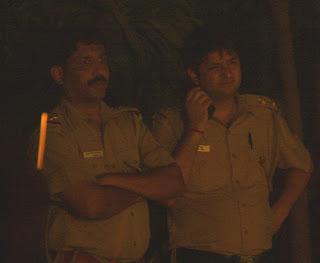
Local police officers watching fireworks for the festival of Dussehra.

Every once in a while, we get a visit from our local police officer. He drives up on his motorcycle, his bushy mustache twitching, his facial expression a mix of determination and slight bewilderment. Minutes later the doorbell rings, and he and our landlord are standing in front of the door.

"He needs two copies of your visa and passport," Sanjay (our landlord) says. The police officer nods vigorously and his mustache twitches.

We dash into our rooms to retrieve some copies of our slowly diminishing stash of photocopies of every single documentation we have ever owned. Triumphantly, we emerge with several slightly tattered (that's what happens when you wade through knee-deep monsoon water) photocopies, which the police officer proceeds to turn upside-down and stare at. He finally nods and leaves.

Five minutes later, the doorbell rings again. This time, Sanjay and the police officer march into our apartment and sit down at our dining room table. The police officer, speaking rapid-fire Hindi, hands us the police registration forms we had to fill out when we moved into our apartment 5 weeks ago. He points to a part of the form we forgot to fill out, which goes something like this:

Village:
Village Police Office:
Village Post Office:

(A third of the form is devoted to physical features. It goes something like this (with my responses):
Mustache: no Face: small, round Hair: brown Eyes: brown Identification Mark: USA)

So, Kyle and I write down our respective villages (the small farming village of Zehlendorf, Berlin and the remote tribal area known as Palos Verdes, Los Angeles) and our post office and police offices ("Zehlendorf Police Office"; "Zehlendorf Post Office"). Meanwhile the police officer is looking at the "permanent address" part of Kyle's form with a very confused look on his face.

"This California -- is it district? A country?" he says.
"Oh, it's a state -- like Maharashtra," Kyle explains.
The police officer seems unsatisfied. More discussion in rapid-fire Hindi ensues between our landlord and the police officer on the status of California. Perhaps it is a separatist region? Finally, after much time spent wrinkling his forehead and asking us for five more passport photos, the police officer and the landlord leave, but not before explaining to us the reason of this surprise inspection.

Apparently Delhi is on red alert for terrorist attacks. So, the Lajpat Nagar Police are understandably concerned about foreigners' safety. Should anything happen, I am sure contacting my local post office in Germany via snail mail will guarantee my safety.

In general, security measures in Delhi are a parade of formalities with a whole lot of thin air behind them. Almost every public place (popular restaurants, markets) has a dinky-looking metal detector at the entrance. I've never seen them turned on once. The Delhi metro has much more enhanced security, but a recent encounter I had with a security guard made me think otherwise. I had my huge camera in my purse, which was being screened by a sleepy-looking security guard. As it came out, he looked at me with a big grin and said: "Camera, right?" I flashed him a big smile and said: "Yes, yes!" Of course.

Wednesday, September 16, 2009


At the evening ganges aarthi (prayer ceremony) in the holy city of Haridwar.


My roommates and I jumping in Rishikesh.

A short update:

I have started working for an NGO in a poor Muslim quarter called Nizamuddin Basti in Delhi. The neighborhood -- a Sufi community -- goes back to the 14th century, and is full of beautiful, ancient tombs and mosques. Crammed alleyways and dirty roads will suddenly open up into majestic tombs or anonymous graves hundreds of years old (since so many famous people were buried there, everyone wanted to be buried there). It is a common sight to see residents of the neighborhood sitting on these anonymous marble tombs, going about their business. The daughter of Shah Jahan (who built the Taj Mahal) is buried here. I have been teaching English conversation to girls aged 11-19, all of whom have had to drop out of school for various reasons (their families are often very conservative). The girls are very sweet and VERY eager to learn English. While they don't know much English -- I taught them a simple "How is the weather" dialogue last week -- today I found out that they have been hiding their vast knowledge of English beauty terminology from me. In a conversation about what things they had bought for the upcoming festival of Eid (the end of Ramadan, which is apparently celebrated by buying new dresses, earrings, shoes, etc), it emerged that they knew how to say lipliner, eyeliner, mascara, face powder, lipstick, earrings!

I just came back from a weekend trip to Haridwar and Rishikesh, two holy cities along the Ganges to the north of Delhi. It was nice to get away from the heat and crowds of Delhi, although we almost got attacked by several vicious monkeys. Kyle learned an important lesson: when encountering a baby monkey, don't try to kick it, especially if its mother, father sisters and brothers are surrounding you. Check out my most recent flickr album for the pictures!

Tuesday, September 8, 2009

India so far


Indian Bureaucracy at the Foreigner's Registration Office


Silent symbols of protest at the Foreigner's Registration Office in Delhi, where the government officials twiddle their thumbs absent-mindedly as foreigners wait for hours only to be turned away for the most arbitrary reasons (which vary depending on the mood of the government employees). When you get there, you have to wait in line just to get a form (and give all the people cutting the line a fierce elbow-jab), then you fill out the form, and wait in line again. Then the official spends what seems like hours poring over your documents ("You are needing 15 passport photos" - "But your colleague told my friend yesterday to bring 10!"). Then, if you are lucky, they are deemed acceptable and the "In Charge" takes one last look at them and, if you are lucky, signs your forms. When I was there, the electricity went out three times -- the two government officials at my counter mysteriously disappeared the first time, returning an hour later with something yummy wrapped in newspaper -- and the man from Maryland standing behind me almost burst into tears. Thankfully mine went smoothly, mostly because the "In Charge" was chatting with her colleague while she was signing my registration permit.


This is our cushy apartment in Lajpat Nagar, a middle-class Indian neighborhood in South Delhi. Most of the people in the neighborhood are descendant from Punjabi refugees who fled what is now Pakistan during India's Partition in 1947. We live above our landlord, who has treated us like family members. He lives with his two sons, his wife and his 60 or 70-something mother. She is this very regal, handsome-looking woman who has told us repeatedly, while clutching our chins affectionately but rather forcefully, "I. am. your mother. You are. my children. Ok?" She is very sweet but I can tell she has the say in this household. I've seen her give the cleaning lady looks that could fry a monkey.


This is our street.


This is the outside of our apartment building. Our landlord's wife owns a beauty salon ("saloon") on the ground floor. A pedicure is only 4 dollars!


The Delhi flower market in the morning. Check out my flickr album for more pictures! Just click on the link on the right.


This is the Lajpat Nagar Central Market, two minutes from our house. It's one of the biggest markets in Delhi. I'm trying to not shop there every day.


These are my lovely roommates after a home-cooked Indian meal! Kyle, Lauren and Dodie!